
Milton’s difficult seventeenth-century poem imagines Satan’s rebellion, the creation of the world, the temptation of Adam and Eve, humanity’s fall, and the promise of redemption. Some of our best conversations began with a simple question: If Satan cannot defeat God, what can he do?
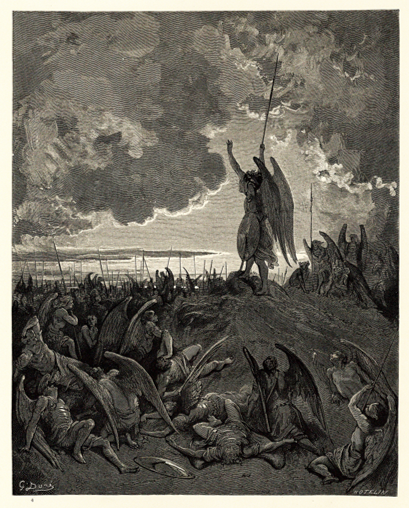
Milton’s answer is that Satan attacks what God loves. He cannot create a world, life, freedom, intelligence, beauty, or power. He can only take what God has made and turn it against its purpose. Freedom becomes rebellion, courage becomes defiance, reason becomes rationalization, and love becomes possession. Evil is parasitic: it must borrow something good before it can corrupt it.
Senior Micah Berg described Satan’s reasoning this way: “Satan wanted to take what God made and claim it as his own, to claim that it was his power that did what he could not explain.”
In Book V, Satan denies that God created him. Because he cannot remember beginning to exist, he calls himself “self-begot” and “self-raised” and declares to his fellow fallen angels, “our puissance [power] is our own.” Satan confuses possessing a gift with being its source. He wants existence without a Creator, power without dependence, freedom without relationship, and glory without gratitude.
Senior Owen Williams recognized that control is at the center of Satan’s rebellion: “Even Satan debated within himself whether evil was the right decision. He wanted to be in control of his life more than he wanted to give credit to God.”
Milton’s Satan sometimes understands exactly what he has done. He remembers the goodness he received, considers repentance, and confesses, “Which way I fly is Hell; myself am Hell.” He cannot get beyond himself long enough to repent.
Senior Alice Walker observed, “I liked [the part] where Satan was thinking about repenting and how he couldn’t do it. Because his focus was self-centered, he couldn’t get past himself to consider repenting.”
Satan regrets his suffering, but he does not yet love goodness, he long to possess it. He wants relief from Hell without surrendering the self that produces Hell. The class could relate to the temptation to want to control our lives, claim credit for our accomplishments, resist dependence, and treat gratitude as weakness.
Against Satan’s possessiveness, Milton presents creation as gift. Only God creates from nothing, but human beings participate in “sub-creation.” As gardeners, Adam and Eve received soil and seed, in worship they received language and music. We receive created goods and help their possibilities become fruitful.
The contrast can be summarized this way:
Humanity is given good, recognizes it as gift, cultivates it, and shares its fruit. Satan is given good, claims it as his own, corrupts its purpose, and spreads the ruin.
This also explains the temptation in Eden. Adam and Eve possess an abundant world with only one tree withheld. Satan moves Eve’s attention away from everything God has given and toward the single boundary. Her question changes from “Why has God given us so much?” to “Why is God keeping this from us?”
When Eve eats, Milton writes simply, “She plucked, she ate,” followed by the extraordinary statement, “Earth felt the wound.” Humanity was created to cultivate and protect creation. When the stewards join the destroyer, creation itself is injured.
Freshman Florence Claassen said the description of Creation’s injury “makes me think about the fall from a different view.” This different view of the fall was the central idea our class discovered in Paradise Lost: Humans are made to receive, cultivate, and steward. Satan claims, consumes, and corrupts.
Milton’s epic gives the students a vocabulary for asking difficult questions: What is freedom? What does it mean to receive life as a gift? Why does evil disguise itself as independence? What is the difference between love and possession? Can what has been wounded become something more than merely repaired?
Leave a Reply
Want to join the discussion?Feel free to contribute!