
After completing John Milton’s Paradise Lost, our high school humanities class turned to Daniel Defoe’s Robinson Crusoe. The two books appear very different. One describes a war in Heaven and humanity’s expulsion from Eden, the other follows a shipwrecked sailor learning to grow grain, make pottery, domesticate goats, and survive on an island. Yet both works ask a similar question, Will human beings receive creation as a gift, or will they attempt to possess it as though it belonged entirely to them?
Even after Robinson is shipwrecked on a remote island, his first instinct is possession. He inventories everything he recovers from the ship, builds walls, measures his land, and gradually imagines himself as the ruler of his island. He transforms a few seeds of grain into bread, clay into pots, trees into shelter, and wild land into a place capable of sustaining human life.
This is human “sub-creation.” Robinson does not create anything from nothing. He receives soil, seed, rain, animals, intelligence, time, and strength, and then cultivates their possibilities. The lingering question is whether he will recognize them as gifts.
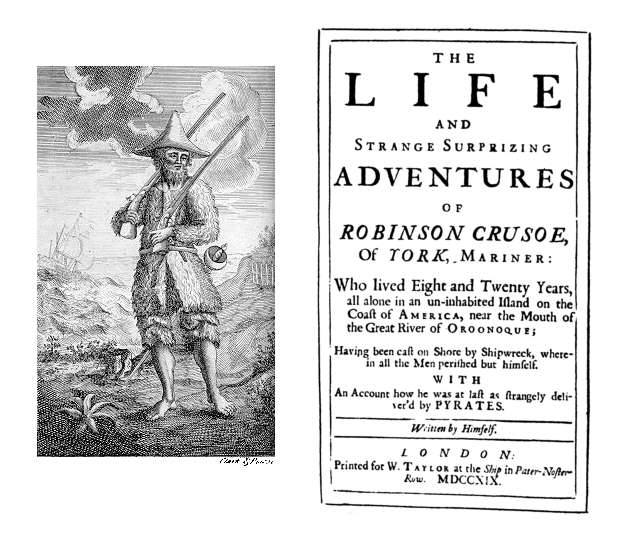
Freshman Eden Barth described Robinson’s transformation: “Robinson at first did not see creation necessarily as a gift. However, the longer he was on the island, the more he saw God’s providence in nature and viewed creation as a gift.”
At first, Robinson measures his circumstances almost entirely by what he lacks. The island is a prison because it is not the life he intended to possess. Over time, however, he begins to notice what has been preserved rather than only what has been lost. He has survived when everyone else died. Supplies from the wreck remain available. Grain grows unexpectedly. The land produces food, and his body retains the strength to work.
The island itself has not changed. Robinson’s vision has changed. What once appeared only as deprivation begins to look like providence.
Sophomore Nahla Greene expressed the tension well: “Crusoe makes himself a ruler over his island, but eventually recognizes that all he has is God’s.”
While Robinson learns gratitude, but he does not immediately unlearn domination. He can thank God for providence while still assuming that Providence has placed other people beneath him. Defoe allows us to see how easily religious language can coexist with habits that have not yet been transformed.
Freshman Paxton Herrs compared Robinson with Milton’s Satan: “Robinson views creation as though he does not own it but should rule over it. Satan thinks he should have power over creation and that it is from Satan, not God.”
That distinction helped us continue an idea from Paradise Lost. Satan possesses created life and power but refuses to acknowledge their source. He declares that his power is his own and attempts to turn Hell into a kingdom of his making. Robinson also seeks mastery, but he gradually learns that cultivation does not make him creation’s ultimate owner.
Sophomore Isaac Alexander put it this way: “While Satan and Robinson had very separate viewpoints, Robinson learned to enjoy the gift he had received on the island, whereas Satan tried to claim possession of the island [Hell] he was on.”
Satan looks at what he has received and says, “This is mine because my power made it.” Robinson slowly learns to say, “I have worked for this, but I did not create the soil, the seed, the rain, my strength, or the life that allows me to work.”
This does not diminish Robinson’s labor. It gives his labor its proper meaning. Gratitude does not require pretending that human effort is unimportant. It means recognizing that effort itself depends upon gifts we did not give ourselves.
Robinson’s story therefore moves, imperfectly, from possession toward stewardship. I own this because I mastered it becomes I have been entrusted with something I did not create.
That movement is incomplete, and Robinson’s treatment of characters like Xury and Friday troubled the students. If creation is truly gift, then other people cannot be reduced to possessions, servants, or supporting characters in our own story. Receiving creation faithfully means recognizing that our neighbor has also been created by God and possesses a life that does not belong to us.
That may be one reason Robinson Crusoe remains worth reading. Robinson is neither a simple hero nor a simple hypocrite. He is a person whose vision changes before all his habits do. He learns to see providence in the island but does not always recognize the full implications of that belief.
Join us for a free Raising Sturdy Kids mini-session with Keith McCurdy, M.A., Ed.S. A national family and parenting educator and consultant, Keith is also a licensed professional counselor and licensed marriage and family therapist in Virginia.
Keith will help parents see how allowing children to face challenges can prepare them to become sturdy adults who meet life with courage and determination.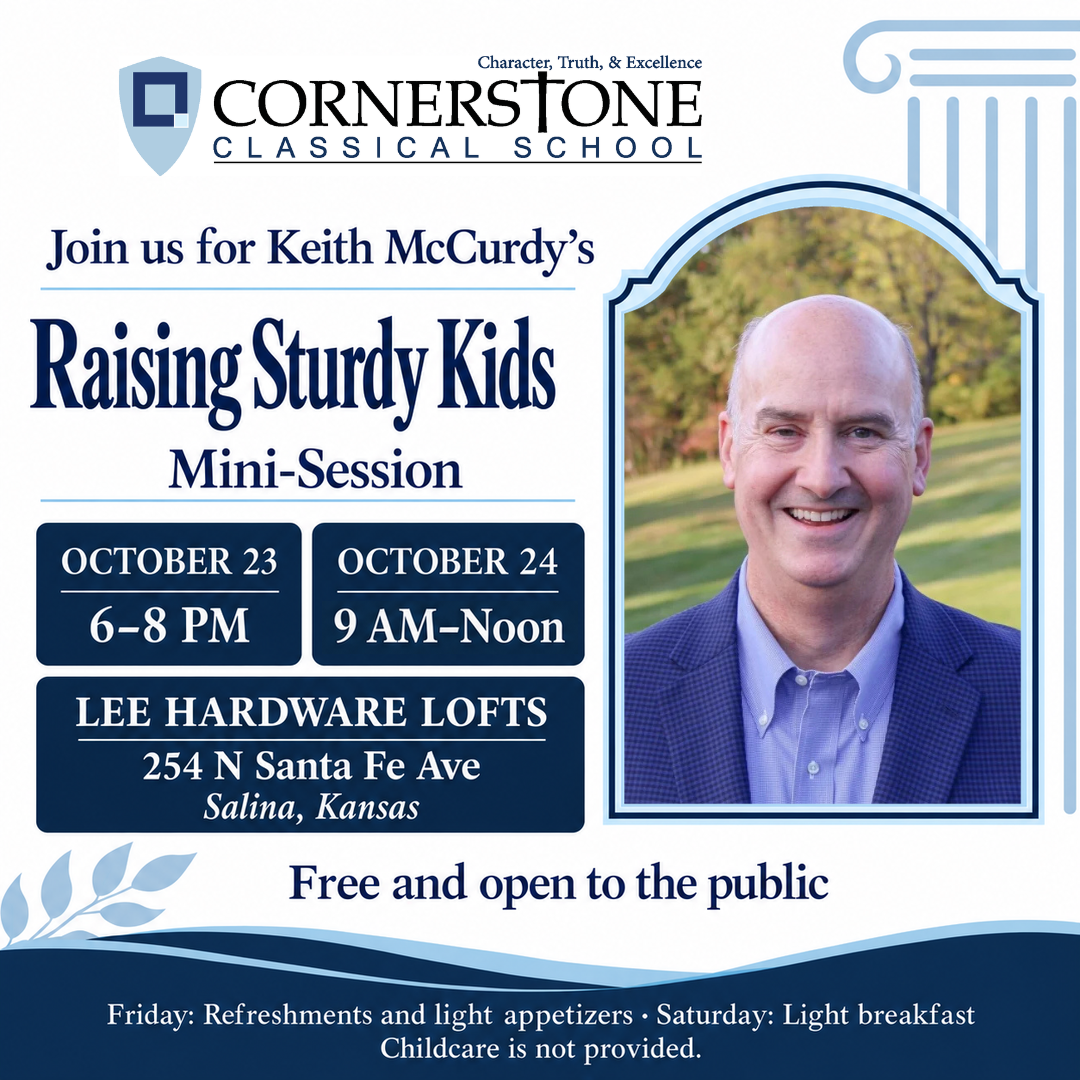
Make it an extended date night! We’ll gather at Lee Hardware Lofts in Salina on October 23 from 6–8 PM and October 24 from 9–Noon. We can’t wait to see you.
Learn more about Keith at livesturdy.com, and more about Cornerstone Classical School at cornerstonesalina.com.
Milton’s difficult seventeenth-century poem imagines Satan’s rebellion, the creation of the world, the temptation of Adam and Eve, humanity’s fall, and the promise of redemption. Some of our best conversations began with a simple question: If Satan cannot defeat God, what can he do?
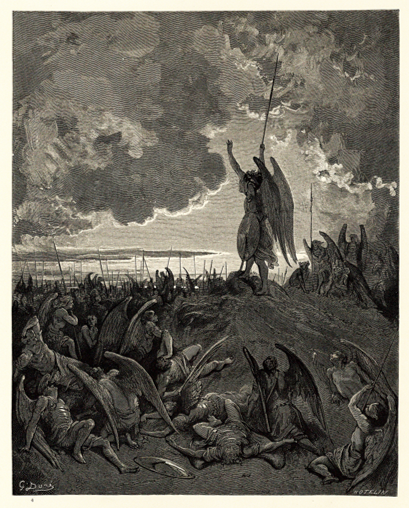
Milton’s answer is that Satan attacks what God loves. He cannot create a world, life, freedom, intelligence, beauty, or power. He can only take what God has made and turn it against its purpose. Freedom becomes rebellion, courage becomes defiance, reason becomes rationalization, and love becomes possession. Evil is parasitic: it must borrow something good before it can corrupt it.
Senior Micah Berg described Satan’s reasoning this way: “Satan wanted to take what God made and claim it as his own, to claim that it was his power that did what he could not explain.”
In Book V, Satan denies that God created him. Because he cannot remember beginning to exist, he calls himself “self-begot” and “self-raised” and declares to his fellow fallen angels, “our puissance [power] is our own.” Satan confuses possessing a gift with being its source. He wants existence without a Creator, power without dependence, freedom without relationship, and glory without gratitude.
Senior Owen Williams recognized that control is at the center of Satan’s rebellion: “Even Satan debated within himself whether evil was the right decision. He wanted to be in control of his life more than he wanted to give credit to God.”
Milton’s Satan sometimes understands exactly what he has done. He remembers the goodness he received, considers repentance, and confesses, “Which way I fly is Hell; myself am Hell.” He cannot get beyond himself long enough to repent.
Senior Alice Walker observed, “I liked [the part] where Satan was thinking about repenting and how he couldn’t do it. Because his focus was self-centered, he couldn’t get past himself to consider repenting.”
Satan regrets his suffering, but he does not yet love goodness, he long to possess it. He wants relief from Hell without surrendering the self that produces Hell. The class could relate to the temptation to want to control our lives, claim credit for our accomplishments, resist dependence, and treat gratitude as weakness.
Against Satan’s possessiveness, Milton presents creation as gift. Only God creates from nothing, but human beings participate in “sub-creation.” As gardeners, Adam and Eve received soil and seed, in worship they received language and music. We receive created goods and help their possibilities become fruitful.
The contrast can be summarized this way:
Humanity is given good, recognizes it as gift, cultivates it, and shares its fruit. Satan is given good, claims it as his own, corrupts its purpose, and spreads the ruin.
This also explains the temptation in Eden. Adam and Eve possess an abundant world with only one tree withheld. Satan moves Eve’s attention away from everything God has given and toward the single boundary. Her question changes from “Why has God given us so much?” to “Why is God keeping this from us?”
When Eve eats, Milton writes simply, “She plucked, she ate,” followed by the extraordinary statement, “Earth felt the wound.” Humanity was created to cultivate and protect creation. When the stewards join the destroyer, creation itself is injured.
Freshman Florence Claassen said the description of Creation’s injury “makes me think about the fall from a different view.” This different view of the fall was the central idea our class discovered in Paradise Lost: Humans are made to receive, cultivate, and steward. Satan claims, consumes, and corrupts.
Milton’s epic gives the students a vocabulary for asking difficult questions: What is freedom? What does it mean to receive life as a gift? Why does evil disguise itself as independence? What is the difference between love and possession? Can what has been wounded become something more than merely repaired?
Here is a link to sign up for all of our summer camps.
Cornerstone Classical School Summer Camps
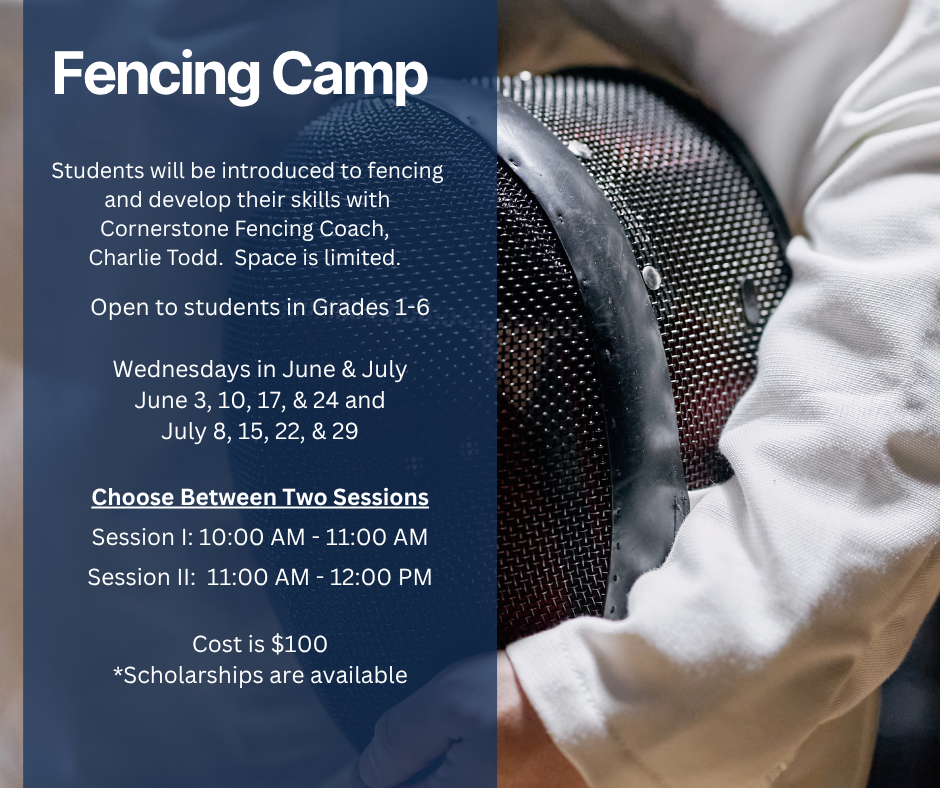
Fencing Camp details are below:
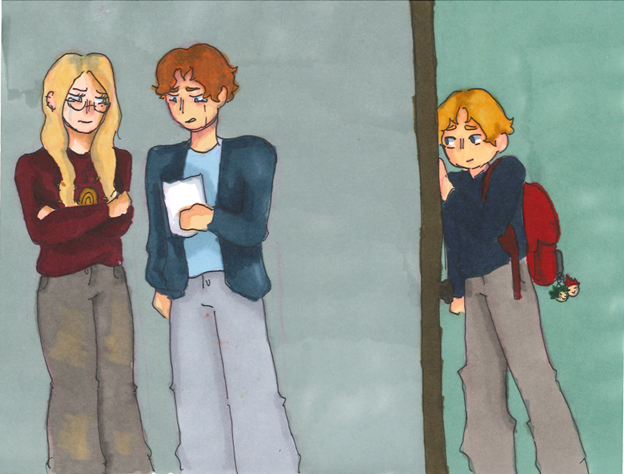
Students in the Cornerstone Classical School Upper School humanities program recently received an unexpected and memorable gift: a small illustrated book drawn directly from The Iliad, one of the central texts studied during the year. Titled A Young Scholar’s Bedtime Story, the book was written by their humanities professor and illustrated by Micah Berg, a student in the class.
The book reframes the epic violence of The Iliad as a mock “bedtime story” for students. Written in elevated, Homeric language, the text imagines a child lying awake at night, hearing the quiet sobs of a parent elsewhere in the house because the parent has just reviewed the student’s report card; and turning to The Iliad for comfort. The irony is intentional. Scenes far too violent to read to children are presented as soothing precisely because they drown out anxiety, guilt, and fear about grades and expectations.
The book is not an isolated novelty. It emerges from a rigorous humanities curriculum in which students read and discuss foundational texts of the ancient world, including The Iliad, Plato’s Republic, Euripides’ Bacchae, Aristophanes’ Clouds, and Thucydides’ Peloponnesian War. These works are not treated as museum artifacts but as living conversations. Guided classroom discussion invites students to wrestle seriously with questions of justice, power, virtue, reason, madness, rhetoric, violence, and the limits of human wisdom.
In these discussions, students are not merely asked what the texts say, but what they assume about reality. Homer’s glorification of heroic violence, Plato’s confidence in rational order, Euripides’ exposure of the inaccessibility of a god, Aristophanes’ satire of intellectual arrogance, and Thucydides’ grim realism about politics and war all present competing visions of what it means to be human created in the image of God. The classroom becomes a place where students learn to name these visions, compare them, and critique them.
Crucially, the goal of this engagement is not simply historical literacy. Students are challenged to return to Scripture with sharper eyes and deeper questions. By encountering ancient pagan attempts to explain suffering, justice, power, and the divine, students are better equipped to see what is distinctive about the biblical vision of God. The Bible is not read in isolation, but in conversation with the ancient world it emerged from and spoke into.
A Young Scholar’s Bedtime Story captures this vision in miniature. The book quotes directly from The Iliad, often selecting some of its most graphically violent passages, and follows each with darkly comic, lullaby-like commentary. The humor works because students know the text well; they have already read these scenes seriously in class. What changes is the frame. The epic’s violence becomes a mirror for modern academic anxiety, parental expectation, and the pressure to succeed.
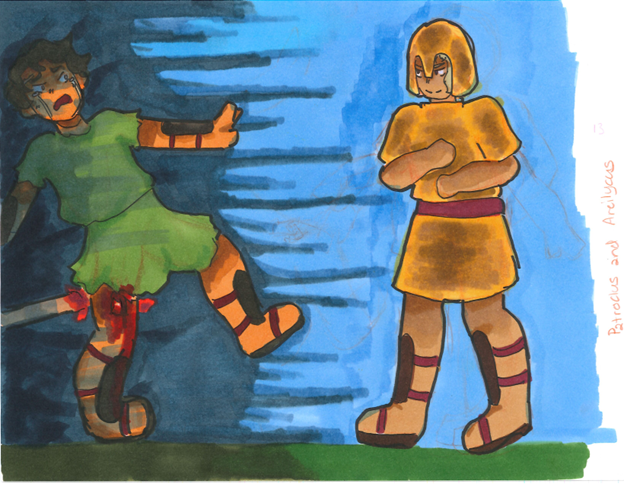
The illustrations by Micah Berg add another layer of meaning. Created by a student who has wrestled with these texts firsthand, the artwork reflects a central aim of classical education at Cornerstone; students are not only consumers of great works, but participants in an ongoing tradition of reading, responding, and creating.
Far from trivializing Homer or the humanities, the book underscores their enduring power. Ancient texts persist because they speak honestly about fear, failure, ambition, and hope. By placing The Iliad at the bedside of anxious students, Cornerstone’s humanities program reminds them that they are not the first young people to live under the weight of expectation or to seek rest amid disappointment.
In the end, the bedtime story does what classical education always seeks to do; comforts without lying, challenges without crushing, and invites students to keep thinking: about the ancient world, about Scripture, and about the God who meets them in both.